LUCI Supports Portugal’s New 2026 Wildfire Susceptibility Map with LandOS


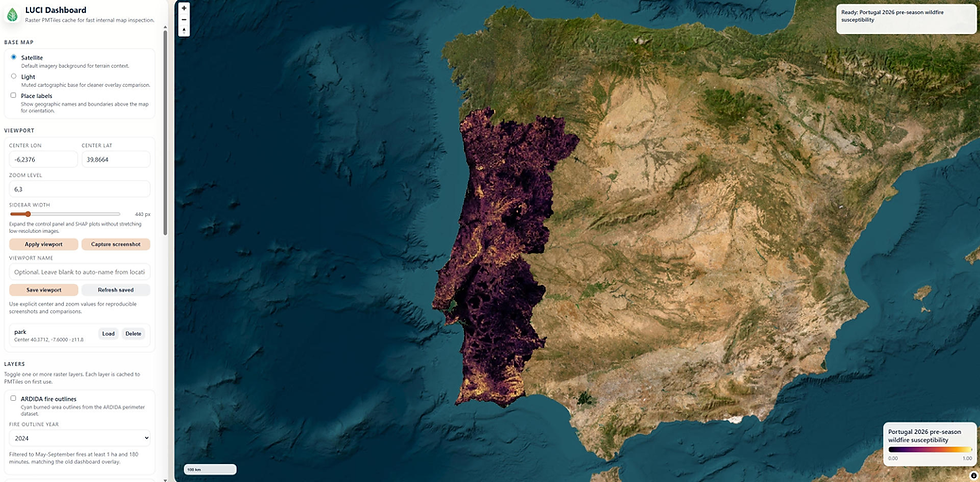
Wildfire risk is dynamic. It changes with the seasons, with vegetation growth, with recent fires, and with shifts in land use and weather conditions. To support more timely and actionable wildfire preparedness, we are excited to share our collaboration with LandOS on Portugal’s new 2026 wildfire susceptibility map.
The map is now live at 10-metre resolution across all 3,049 mainland parishes, providing landowners, land managers, municipalities, and decision-makers with a detailed view of where wildfire susceptibility may be elevated this season.
From Structural Risk to Seasonal Susceptibility
Long-term wildfire risk maps are essential for understanding the structural characteristics of a landscape. Factors such as terrain, land cover, vegetation type, and historical fire patterns help identify areas that are generally more prone to wildfire over time.
However, wildfire susceptibility also changes from year to year.
A historically high-risk area may currently have reduced fuel availability after a recent fire. At the same time, another area may become more susceptible following strong vegetation growth, increased biomass, or changing land-cover conditions.
This is where a seasonal view becomes valuable.
For this project, we implemented LUCI to translate satellite and landscape data into a seasonal wildfire susceptibility layer. LUCI combines signals such as vegetation condition, fuel load, terrain context, land-cover change, and recent burn history to help identify where current landscape conditions differ from long-term structural risk.
Turning Satellite and Landscape Data into Actionable Insight
The goal of this work is not simply to produce another map. It is to make complex geospatial intelligence more useful on the ground.
By integrating satellite-derived indicators with landscape modelling, LUCI helps provide a more current understanding of wildfire susceptibility. This supports more targeted prevention efforts, better local awareness, and more informed decision-making for those responsible for managing land and reducing wildfire risk.
It shows the value of geospatial intelligence that is not only technically sound, but immediately useful in practice.
Collaboration with LandOS
This project reflects the strength of combining advanced geospatial analysis with accessible digital tools. LandOS is making wildfire susceptibility information available through a live platform designed for landowners and decision-makers, helping bridge the gap between technical data and practical land management.
We are proud to have contributed to this collaboration and to support LandOS in making wildfire intelligence more timely, local, and actionable.
A big thank you to the LandOS team and to everyone involved in bringing this work to life. We look forward to future developments.


Comments