CHRIS: Fast Real-Time Mapping for Large Wildfire Incidents

Updated: Aug 6

When a large wildfire is moving, the first problem is not just knowing that it exists. It is knowing where it is, how fast it is changing, and what the ground teams should do next.
CHRIS is built to create a live 2D overview of a large incident while the drone is still flying. It stitches incoming imagery into a geo-referenced map in real time, giving commanders and ground teams a faster way to understand the size, shape, and movement of a fire as it develops.
For large wildfires, that speed matters. A map that arrives too late is not much help. A map that updates while the incident is still unfolding can change how teams coordinate, how they deploy resources, and how they communicate across the line.
Why CHRIS' Speed Matters
Wildfires change quickly. Fire edges move, wind shifts, access routes close, and a situation that looked stable minutes ago can already be different.
CHRIS helps teams turn drone imagery into an operational map fast, reducing dependence on radio reports, rough estimates, and slow manual interpretation.
What Teams Often Use Today
In many places, incident mapping still depends on a mix of manual and fragmented workflows.
That can mean:
hand-drawn sketches on paper or on a board
field observations relayed by radio
someone tracing fire edges manually
separate photo streams that need to be interpreted later
live video being used to communicate a location or a changing fire edge in a very local way
In some countries and incidents, teams use live feed to show where one part of the fire is, which helps with communication. That can be useful, but it still leaves the larger question unanswered: how do you quickly turn those observations into a shared operational map for the whole incident?
That is the gap CHRIS is meant to close.
What CHRIS Does Differently
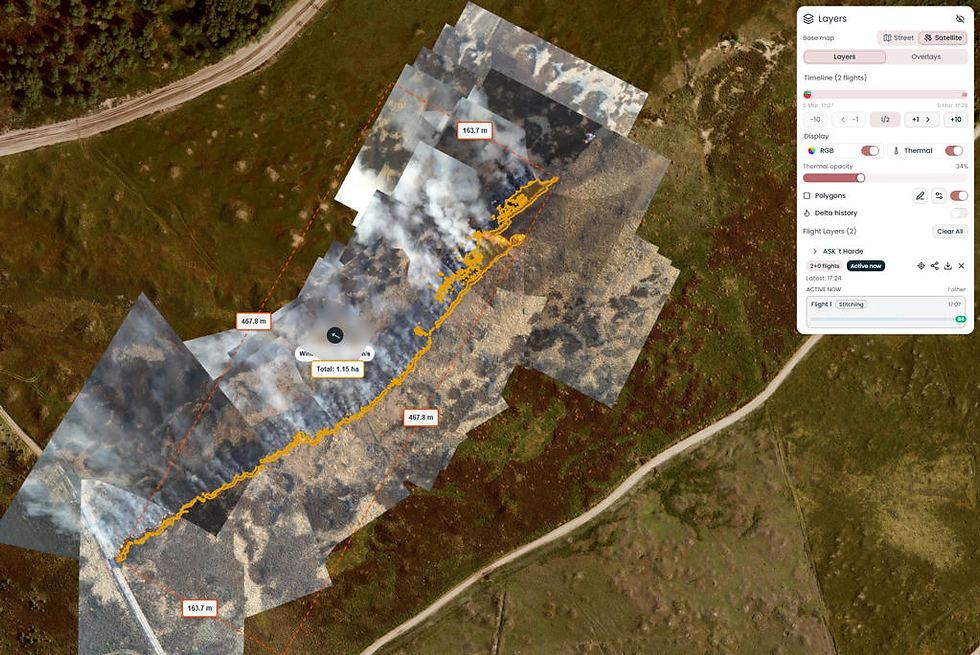
CHRIS takes drone imagery and stitches it into a real-time 2D map, so the incident can be understood as a larger, connected shape rather than a series of disconnected images.
That gives teams a few important advantages:
a faster overview of the whole incident area
a clearer view of the fire perimeter and how it is changing
a shared map that supports coordination between command and ground teams
less reliance on slow manual drawing and interpretation
a more consistent picture when decisions have to happen quickly
The value is not just that CHRIS makes a map. It is that it makes the map fast enough to matter.
Real-Time Stitching For A Larger Area

As the drone flies, CHRIS processes images and builds a geo-referenced overview of the area. Teams do not have to wait until after the flight to understand what was seen.
That is especially useful for large incidents, where the main challenge is understanding the full fire front, not just one hotspot.
Infrared and Night Operations
CHRIS also works with infrared imagery, helping teams maintain situational awareness after dark when visibility drops and the incident is still active.
Delta Views: What Has Changed Since The Last Update
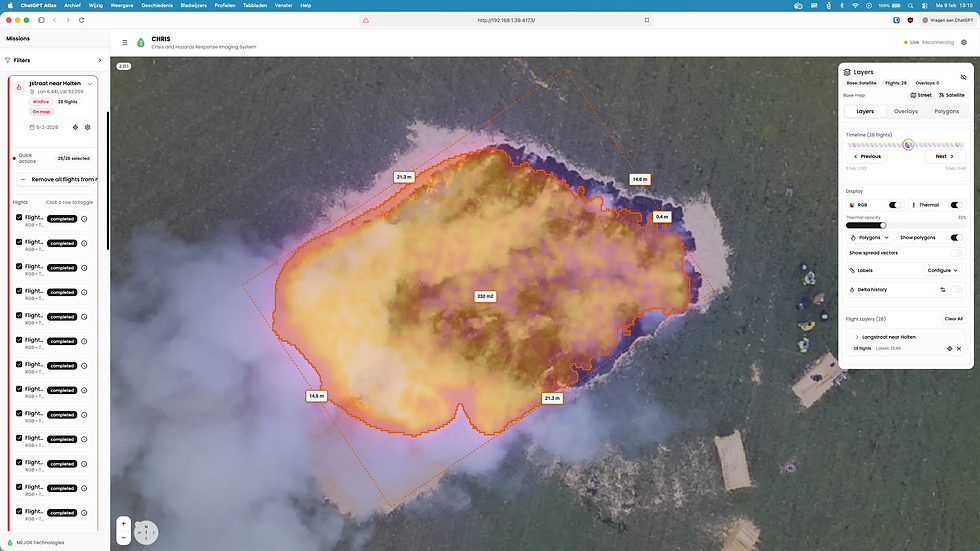
CHRIS can compare the current map with the previous one to show what has changed since the last update. That makes it easier to see fire growth, perimeter movement, and shifting conditions.
For command teams, that means a faster answer to a simple question: what changed since the last update?
Better Coordination On The Ground
CHRIS gives command and ground teams the same live picture, which improves communication, helps crews focus on the right areas, and supports faster repositioning of resources.
The Bigger Picture
Large wildfires are rarely managed through one single tactic.
They are managed through a chain of decisions, updates, and coordination across the incident. The faster the team can build a shared picture of the fire, the better those decisions become.
CHRIS is designed to make that picture available sooner.
It stitches large-area maps in real time, supports infrared mapping at night, shows delta changes between updates, and helps ground and command teams work from the same incident view instead of separate fragments.
That is the real value.
Not just mapping the fire.
Mapping it fast enough to change the response.


Comments